INTERVIEW WITH KATHERINE PACKERT-BURKE
Katherine Packert-Burke is a graduate of the Clarion Writer’s Workshop in San Diego and the MFA program at the University of Alabama. Her first novel, Still Life, was published in 2024. She lives in Minneapolis, MN and is on Twitter @katpburke. Katherine is represented by Danielle Bukowski at Sterling Lord Literistic.
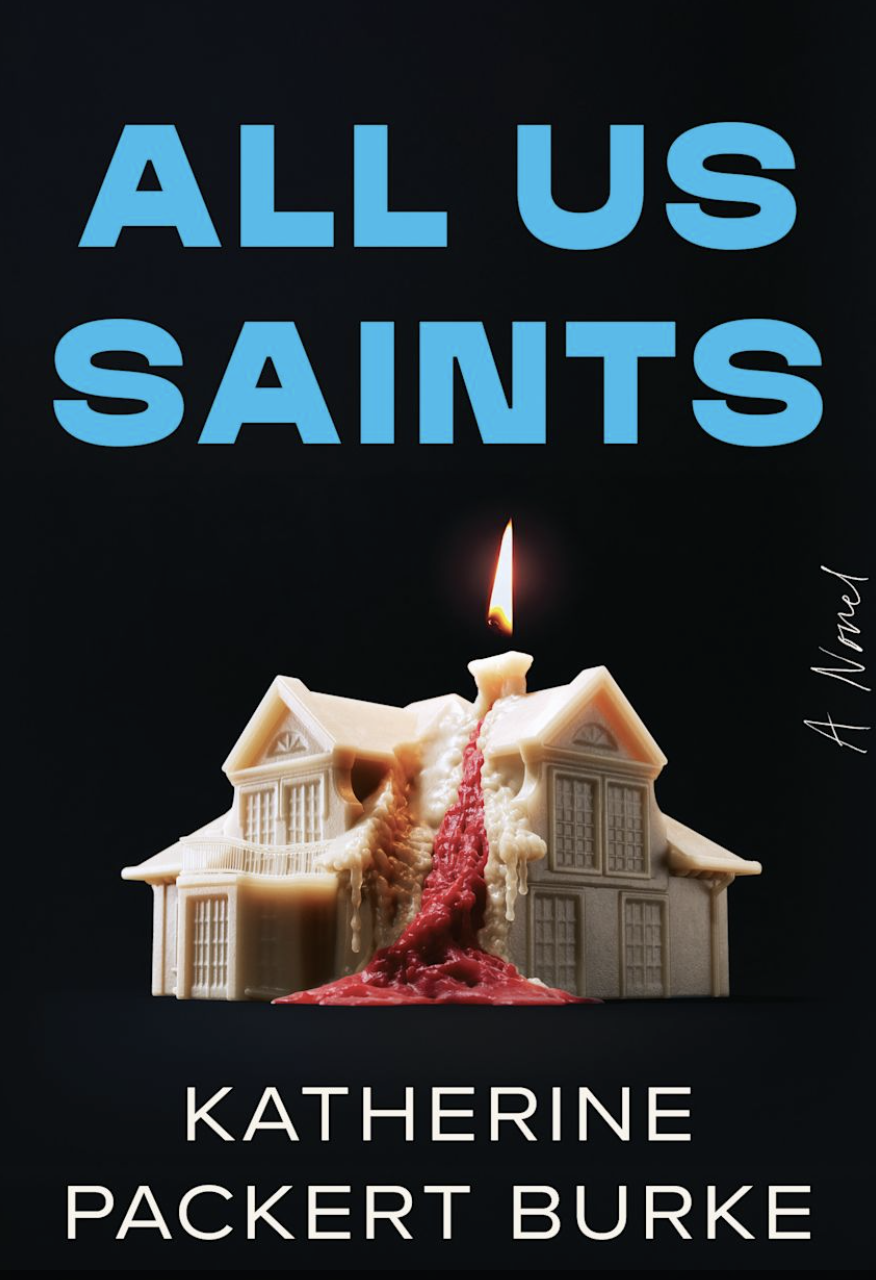
Her second novel, All Us Saints, was recently published by Bloomsbury.
Exactly 19 years ago, in May of 1992, 17-year-old Roland St. Cloud fatally stabbed his twin sister Edna's three best friends. The slaying became instant tabloid fodder leading to a bestselling true-crime book and horror movie franchise. Each year on the anniversary of her family's undoing, Edna reenacts the murders. She is joined by her husband, Roger, the night's definitive chronicler; her younger sister Calla, a failed playwright who spends her days lost in online gaming; her younger brother James and his girlfriend Heather; and her teenage daughter Wren. Together, the St. Cloud family seals the windows and doors of the house and lights a grim candle. After their macabre theatrics there's nothing to do but wait for dawn, talk among themselves, and remember.
All Us Saints is a literary family drama packaged as a two-act play. Behind the curtain, Packert Burke unveils Roland's childhood as a closeted trans girl in the early 90s and offers a brilliant and scathing commentary on the cisgender gaze. – Bloomsbury
Katherine sat down with us to discuss All Us Saints.
MENACE: Congratulations on a riveting second novel. It’s a cliché at this point, but I couldn’t put it down, and I’m so excited to talk with you today about it.
First question—I notice several of the characters are playwrights—Calla, the St. Cloud parents. One thing I love about the novel is how much it resembles a play. The small cast, the closed set, the two acts. So much is accomplished through dialogue, and even when characters take phone calls we only hear their side of the conversation, like we would in a play. How much would you say that this book was inspired by the theatre?
KPB: Theater has been one of the consistent themes in both my published novels—my dream is that after like two more some critic will come along and explain to me what the hell my deal with it is, because I’m not sure. I grew up going to plays (one of my earliest memories is of being confused, in a movie theater, that the characters were not coming out to perform in front of the screen) and acting. Ultimately, theater was both a way of structuring the narrative, forcing the characters to interact with one another, and also—because their parents were playwrights—a reflection of the enduring influence the past has on the siblings’ lives.
MENACE: What were your other influences? I’m particularly interested because this book is so different from your debut, STILL LIFE, which seems more—I don’t know if you’d use this word—autofictional. And what do you see as the through lines between this work and that one?
KPB: I’d definitely call STILL LIFE autofictional, but as much as anything it’s playing with the idea of what constitutes autofiction and what we expect from semi-biographical novels by women. Similarly, I think ALL US SAINTS is playing with the ideas of true crime, the gothic novel, the family drama. I’m always very interested in the inner workings of genre—the ineffable qualities that define the experience I have reading it—and curious how far I can bend those things to support my own interests. SL was autobiographical the way a lot of first novels are, but it was the sixth novel I wrote and the only one that drew that heavily from real life. It makes sense that it would not register to the reader as a formal experiment, but that was very much how it felt to me in writing. For all its differences, AUS is a similar kind of experiment.
MENACE: I think one of the things that is so astonishing about the book is that though it reads like fiction, I really believed reading it that the crimes at its heart actually happened. It weaves in real films with fictional ones and real history with fictional history in such a way that it’s hard for me as the reader to tell where you as the author took artistic liberties. But we know the St. Cloud murders didn’t actually happen. The effect, I find, is that one can’t help but reflect on the similarity of our society to the society that was shaped by these murders, the fact that we still very much live in a society where trans people are viewed with fear and disgust, and that’s actually even worse because it’s even less justified.
KPB: It probably helps that I was drawing on the very real murders and grave robbings committed by Ed Gein in 1950s Wisconsin! Gein was eventually portrayed as gender-confused in this very Freudian way—he loved his mother and didn’t start committing the crimes that would make him famous until after she died. The reportage on him gave direct rise to the novel (and eventual film) Psycho, and then Texas Chain Saw Massacre, and then Silence of the Lambs. But there is very little actually understood about him or his motivations; a lot of the gender-confusion came from interviewers asking, “Well this is why you did the things you did, right?” and him not disagreeing—putting words in his mouth. I wanted to think about the legacy that a crime can have, the way that representation and misrepresentation can echo throughout the culture for decades after.
MENACE: Like so many great books, it feels like ALL US SAINTS is about many things. One theme I see is the morality of art. We often see—and certainly as a mag we generally espouse this—the view that creating art is a moral good. But this book complicates that idea a bit. In this book, art almost becomes something perverse. It’s something the St. Cloud parents were obsessed with over seeing and loving their children as real people. There’s Calla’s whole diatribe against art, in which, I have to say, she makes some pretty good points. The murders are linked to Roland’s art and both are, and sort of become, aesthetic. And then obviously there’s all the art made about the murders, which creates stereotypes and profits off people’s trauma. Did you set out to write so much about art when you decided to write this book or was that theme something that surprised you? As an artist yourself, I figure you’re not as completely down on art as Calla is, but I’d be curious to hear a little more about your take on it.
KPB: I definitely didn’t set out to write about art to this degree—but, much like the fabled scorpion that stings the frog that carries it across the water, I can’t help myself. Back when I was just starting out writing, I read a By the Book interview with Colson Whitehead where he said the following: “I don’t know the name of my favorite novelist of all time, because they never wrote anything. They had no inkling they had a knack for writing, so instead channeled that talent into being really nice to family, friends, and strangers. It seems like a better way to spend one’s time, and a higher art.” That, obviously, has Whitehead’s characteristic irony behind it, but there is a part of me that constantly butts up against the question of whether or not my writing improves the world as much as, say, volunteering or political organizing or whatever would. I think this is an impossible question to answer, and the truth is that one doesn’t preclude the other. But I try to live my life in a way where art-making takes as little from regular life as possible; I’ve been waking up at 5am every day to write before my fiancee is awake so that it doesn’t take away from our time together. This is in contrast to, say, the St. Cloud parents, who routinely ignore their children in favor of their writing.
MENACE: The next issue of M E N A C E (coming out fall 2026) is probably the one that most centers gender. It features a lot of pieces about the experience of girlhood, the trans experience, the experience of gender-nonconformity, and I’m really excited to bring it out into the world. Our mag also has a particular penchant for literary horror. I don’t know if you would classify ALL US SAINTS as horror—maybe a thriller or even a character drama—but with its subject matter it certainly at least feels horror-adjacent. But it also speaks to how horror can be a reactionary genre, especially when it comes to its treatment of gender minorities. I think there’s been a lot of great work in the past few years to make more horror from the margins. Is there any of that work that particularly excites you? How can people working in horror break from its reactionary lineage and make art that is worthwhile?
KPB: Oh god yes, there’s so much that excites me. Grace Byron’s Herculine, both of Alison Rumfitt’s novels Tell Me I’m Worthless and Brainwyrms. Gretchen Felker-Martin’s novels, particularly Cuckoo. The films of Jane Schoenbrun and Alice Maio Mackay. And from the critical angle, Willow Catelyn Maclay and Caden Mark Gardner’s Corpses, Fools, and Monsters, which is the most comprehensive study (to my knowledge) of transness on film. The reactionary lineage of horror is complicated; on the one hand, it can generate or perpetuate these ideas of queerness that feel inescapable. On the other, at a young age I encountered more mainstream representation of trans people in horror films than anywhere else. Every trans person who likes horror seems to have one or two of these films that they love and are ready to reclaim. For me, that’s Sleepaway Camp, where the trans murderer is perhaps the only actually likeable character in the entire film. There’s no inherent value in representation, but the most enduring of these movies are willing to complicate their killers just enough that there is something there to latch onto, connect with, say, “Okay maybe this person is a monster, but they’re also kind of just like me.”